
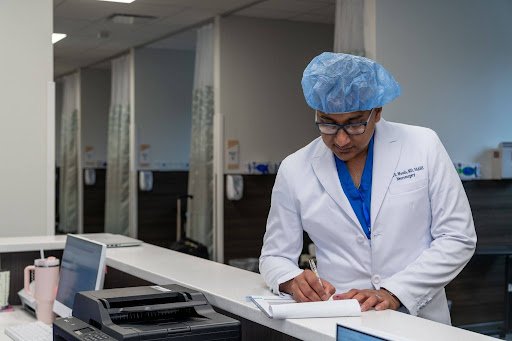
Choosing a spine specialist can feel like trying to read a map while your back hurts and your patience has already left the building. Patients want medical skill, but they also want clear explanations, realistic options, and a physician who sees the person behind the scan. That is why understanding the public profile of Kamal Woods, MD, MBA, FAANS, can be helpful for anyone researching spine care.
Vertrae® describes Dr. Woods as a board-certified neurosurgeon, founder of Vertrae® and Vertrae® Surgery Center, and a spine specialist focused on degenerative spine conditions. His background includes combined orthopedic and neurosurgery spine fellowship training at Cedars-Sinai Medical Center, neurosurgery residency at Loma Linda University Medical Center, and an MBA from Johns Hopkins University. Here are seven practical tips for understanding what those details may mean for patients.
1. Look at the Full Training Path
A physician’s training path tells a story. Dr. Woods’ neurosurgery residency at Loma Linda University Medical Center provided specialty training in conditions involving the nervous system, including the spine, spinal cord, and nerve roots. That matters because many spine symptoms are neurological. Pain, tingling, numbness, weakness, and radiating symptoms may involve compressed or irritated nerves.
His combined orthopedic and neurosurgery spine fellowship at Cedars-Sinai Medical Center adds another layer. The spine is both structural and neurological. Bones, discs, joints, ligaments, nerves, and muscles all work together in a very small space. Training that combines orthopedic and neurosurgical perspectives can support a broader view of diagnosis and treatment planning.
2. Understand Why Board Certification Matters
Board certification is an important professional marker. Vertrae® identifies Dr. Woods as board-certified through the American Board of Neurological Surgery. For patients, this signals that a physician has completed recognized specialty training and met standards within neurological surgery.
Credentials do not replace a personal consultation, but they help patients understand the professional foundation behind the care. Spine decisions can be complex. Some people may benefit from conservative treatment, while others may need advanced procedures. A board-certified neurosurgeon brings formal specialty training to those conversations.
3. Pay Attention to the Conditions Treated
Dr. Woods’ public profile connects his work with degenerative spine conditions, including herniated discs, spinal stenosis, degenerative disc disease, and sciatica. These conditions can affect daily life in very real ways. They may cause neck pain, back pain, arm symptoms, leg pain, weakness, numbness, or difficulty staying active.
The important point is that diagnosis should connect to symptoms and goals. A scan can show anatomy, but the patient explains what life feels like. A thoughtful spine care approach considers both. That is where a specialist’s experience and communication style matter.
For patients researching physician background and spine care options, Dr. Kamal Woods provides a starting point for learning about Vertrae® and its care model.
4. Notice the Role of Patient-Centered Communication
Spine care involves a lot of technical language. Terms like stenosis, radiculopathy, fusion, disc replacement, and decompression can sound like someone spilled a medical dictionary onto the exam table. Clear communication helps patients understand what is happening without feeling overwhelmed.
Vertrae® materials describe Dr. Woods as focused on listening, explaining complex procedures clearly, and making patients feel like partners in treatment. That matters because good care is not only about knowing what to do. It is about helping the patient understand why a recommendation makes sense.
Patients can prepare by asking direct questions: What is causing my symptoms? Do my imaging results match what I feel? What nonsurgical options are available? When would surgery be considered? What does recovery involve?
5. Consider the Value of a Full-Spectrum Spine Practice
Vertrae® describes a complete spine care approach that includes office-based evaluation, diagnosis, nonsurgical treatment, in-house physical therapy, and advanced surgical options when appropriate. That range matters because not every spine condition needs surgery. Many patients may start with conservative care, therapy, injections, medication guidance, or monitoring.
A full-spectrum approach can help patients move through care more clearly. Instead of treating surgery as the only endpoint, the process can focus on matching the treatment to the condition and the patient’s goals. For some, that may mean avoiding surgery. For others, it may mean considering advanced techniques when conservative options are not enough.
6. Recognize How Leadership Shapes Care Delivery
Dr. Woods also holds an MBA from Johns Hopkins University. That business education adds a leadership and systems perspective to his medical background. Healthcare is not only about procedures. It also involves scheduling, patient education, communication, follow-up, safety, technology, and coordination between team members.
For patients, systems matter. A strong clinical plan can still feel stressful if the process is confusing. Leadership training can support a practice model built around organization and patient experience. In plain language, it helps the care journey feel less like a maze and more like a path.
For more information about the physician profile and practice, Dr. Kamal Woods offers details about Vertrae® and its spine-focused services.
7. Connect Innovation With Careful Judgment
Vertrae® public materials reference minimally invasive spine surgery, robotic-assisted techniques, motion-preserving options, disc replacement, spinal fusion, spinal cord stimulation, spinal injections, physical therapy, and conservative care. Innovation can be valuable, but it should always be guided by careful medical judgment.
Newer technology is not automatically the right answer for every person. The best use of innovation depends on diagnosis, anatomy, symptoms, health history, goals, and risk factors. A physician’s role is to determine whether a tool or technique fits the patient, not just whether it exists.
That is why Dr. Woods’ bio is best understood as a combination of training, certification, experience, communication, and leadership. The value is not one credential by itself. It is how those pieces work together to support patient care.
A Clearer Way to Understand a Spine Specialist
Dr. Kamal Woods’ public profile gives patients useful context before beginning a spine care conversation. His neurosurgery background, combined with an orthopedic and neurosurgery spine fellowship, board certification, MBA, and leadership at Vertrae®, all help explain the practice’s patient-centered approach.
For people facing back pain, neck pain, nerve symptoms, or degenerative spine conditions, understanding the physician’s background can make the first step feel less intimidating. A clear bio helps patients ask better questions, understand available options, and approach spine care with more confidence.

