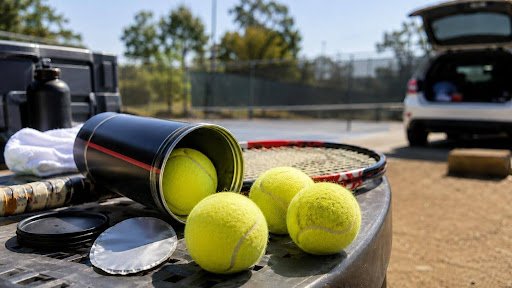
Most recreational players think of a new can of tennis balls as a fresh start. Crack the seal, hear the hiss, and you have three match-ready balls that will last a few sessions before they need replacing. What that hiss is actually telling you is something slightly different: the protection just ended.
The sealed can is doing a job most players don’t think about. Understanding what that job is changes how you think about storing your equipment, and how much of your ball budget you’re quietly throwing away between sessions.
What The Can Is Actually Doing
Tennis balls are pressurized to approximately 14 PSI above atmospheric pressure. Left in open air, that internal pressure drives gas molecules through the rubber core over time. Rubber is porous at a microscopic level, and pressure differentials are what cause gas to migrate through it.
The sealed can solves this by matching the ball’s internal pressure with pressurized gas around it. When there’s no differential between inside the ball and outside the ball, there’s no driving force moving gas through the rubber. The ball sits in equilibrium and holds its pressure.
This is why a can of balls stored correctly can sit on a shelf for two years and still feel fresh when opened. The can isn’t just packaging. It’s a pressure vessel doing active work to keep the ball in match condition. Take that vessel away, and the ball has nothing working in its favor.
The moment you break the seal, that protection disappears entirely.
What Happens Immediately After Opening
Once the can is opened, the balls are exposed to atmospheric pressure while their internal pressure sits around 14 PSI above that. The differential is now at its maximum. Gas begins migrating outward through the rubber immediately, and it doesn’t stop until the ball reaches equilibrium with the surrounding air, which is the same thing as a dead ball.
How fast this happens depends on two things: time and temperature.
At room temperature, a ball left in open air loses pressure steadily. Most recreational players can feel the difference after a week of sitting in a bag. After two weeks the loss is significant. After a month, the balls that felt great in the first session are noticeably softer, harder to hit cleanly, and sitting lower in the strike zone on groundstrokes.
Temperature accelerates everything. Warmer air increases the kinetic energy of gas molecules, which drives faster migration through the rubber. A ball stored at 90°F loses pressure considerably faster than one stored at 65°F, and the relationship is not linear.
As temperature climbs, the rate of loss increases substantially. Humidity plays a secondary role too, with high moisture environments softening the rubber compound slightly and making it marginally more permeable over extended periods.
Where Your Balls Actually Sit Between Sessions
For most American recreational players, the gap between sessions is 48 to 72 hours. During that gap, the balls are typically in a tennis bag. And the tennis bag is typically in a car, a garage, or a spare room.
This is where US conditions matter specifically.
Car trunks in summer in the Sun Belt reach 130°F to 150°F routinely. A bag sitting in a trunk in Phoenix, Dallas, or Orlando during a July afternoon is not just warm; it is hot enough to significantly accelerate pressure loss in opened balls that have zero protective environment around them.
A player who drives to the courts with balls in the trunk, plays a session, drives home, and leaves the bag in the car overnight is compounding the damage across the exact hours when the balls are most vulnerable.
Garages make the problem worse. Uninsulated garages in southern states regularly exceed outdoor ambient temperatures because they trap heat from the floor slab and surrounding structure.
A bag left on a garage shelf between Tuesday and Thursday in August in Texas is not sitting in anything close to the 65 to 70°F that would minimize pressure loss. The balls inside are losing ground continuously, and unlike the sealed can they came in, there is nothing slowing that process down.
Even players who store bags indoors are not necessarily in the clear. Closets near exterior walls, storage areas without air conditioning, and poorly ventilated rooms all create temperature variation that most recreational players never account for when they wonder why their balls feel soft halfway through a session.
The Performance Gap No One Notices
There’s a consistent disconnect in how recreational players assess ball quality. Most gauge it by how the ball looks and how the felt feels. If the felt is intact, the ball seems fine. Pressure loss is invisible. You can’t see it or feel it by squeezing a ball in your hand, and by the time you notice it on court it has usually been happening for longer than you realize.
A ball that feels noticeably flat during warm-up has typically been declining for some time before that point. The performance degradation starts well before it becomes obvious. Players are often competing with suboptimal equipment for the majority of a ball’s post-opening life without connecting it to anything specific.
For US players who play outdoors through summer and store their gear in cars and garages, the gap between peak ball performance and what they’re actually playing with is often wider than it would be for players in more temperate storage conditions. The balls that felt great on Saturday morning are not the same balls you’re hitting with the following Thursday evening, even if they look identical.
What Actually Helps
Storage habits are the starting point. Keeping balls indoors at consistent room temperature between sessions slows pressure loss considerably. Bringing the bag inside after a session rather than leaving it in the car overnight is a simple change with a real impact on how long opened balls stay playable.
For players who want to address the problem more directly, a ball pressurizer removes the guesswork. Products like PressureBall store opened balls at 14 PSI continuously, replicating the sealed environment of an unopened can. With no pressure differential between the ball’s interior and its surroundings, gas migration effectively stops.
The same physics that allows a sealed can to preserve ball pressure for two years applies here. Beyond maintenance, the same principle allows a pressurizer to restore bounce to balls that have already softened, by surrounding them with 14 PSI externally and reversing the differential that was driving pressure out.
For club players going through multiple cans across a season, the cost math is straightforward. A pressurizer that triples or quadruples the usable life of a can running $4 to $6 at most US retailers pays for itself within a few weeks of regular play.
The Hiss, Reconsidered
The satisfaction of cracking a fresh can comes from knowing you’re starting a session with equipment performing exactly as it should. What’s worth understanding is that the can has been maintaining that standard on your behalf since the day it was sealed, and once it’s gone, something needs to take its place.
Most players replace it with nothing. The balls go in the bag, the bag goes in the car, and the slow decline starts on the drive home.